
Stanislaus Court Records After Arrest
After a Stanislaus County jail arrest, the first public record may be the Sheriff's roster. That booking record can show arresting agency, booking date, charges, case number, bail, and court date. The court record starts to matter when the Stanislaus County District Attorney reviews law-enforcement reports and files criminal charges in Superior Court. The DA states that it prosecutes criminal cases filed in Stanislaus County Superior Court and reviews law-enforcement reports to decide whether sufficient evidence supports felony or misdemeanor charges.
Use jail inmate records for current custody and booking details. Use the Superior Court case search for filed case information, hearing dates, charge status, and dispositions. Use jail roster mugshots only for booking-photo questions. A booking charge is an allegation entered at intake; a filed court charge is the prosecutor's formal case record, and a conviction is a later outcome after plea, verdict, or other disposition.
Search Court Records After Arrest
The Superior Court's Search for a Case page links to the Public, Justice Partner, and Attorney Portal. The court page also provides a separate attorney access registration path. The public portal is the official online route for case information when a Stanislaus County arrest has become a filed court case. Research could not inspect the external portal fields because the portal timed out, so exact search tabs and result fields should not be assumed.
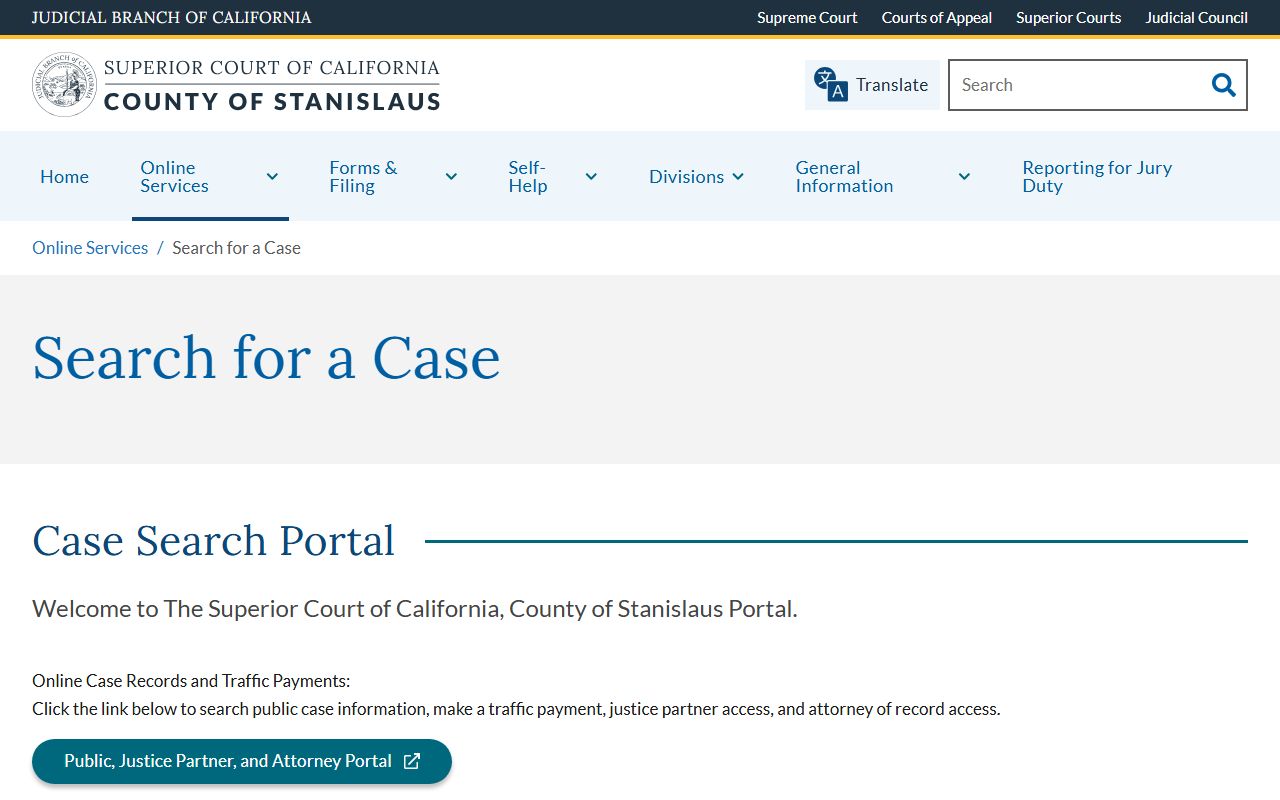
The case-search landing page is useful once the booking record shows a case number or court date, or when the defendant name is enough to locate a filed case.
- Start with the jail roster if the person was just arrested and the case number is unknown.
- Open the court case-search page and follow the public portal link for available public case information.
- Use the booking case number or defendant name if the portal accepts those fields.
- Check each charge, hearing date, warrant entry, bail entry, and disposition separately.
- If online access does not confirm the case, use the Criminal Division courthouse computer or research request process.
Stanislaus Criminal Court Contacts
The Stanislaus Superior Court Criminal Division has jurisdiction over felonies, misdemeanors, and infractions. The Criminal Division contact page lists phone 209-530-3100 #4, office hours Monday through Friday, 8:15 a.m. to 4:00 p.m., and phone hours near the criminal contact listing from 8:15 a.m. to 3:00 p.m. Criminal request email is Criminal.Requests@stanct.org. Mailing goes to Criminal Division, 800 11th Street, Room 140, P.O. Box 1098, Modesto, CA 95353. Delivery and FedEx use 800 11th Street, Room 100, Modesto, CA 95354.
The court warns that staff are not authorized to give legal advice and do not confirm personal or case identity information by phone or email unless there is a court business need. Personal information includes date of birth, the last four digits of a Social Security number, address, or driver's license number. People seeking that information may need to visit the courthouse to use a court-provided computer or submit a Research Request Form.
The Criminal Division page shows the local contact paths for court records after arrest and explains how courthouse research may be handled.
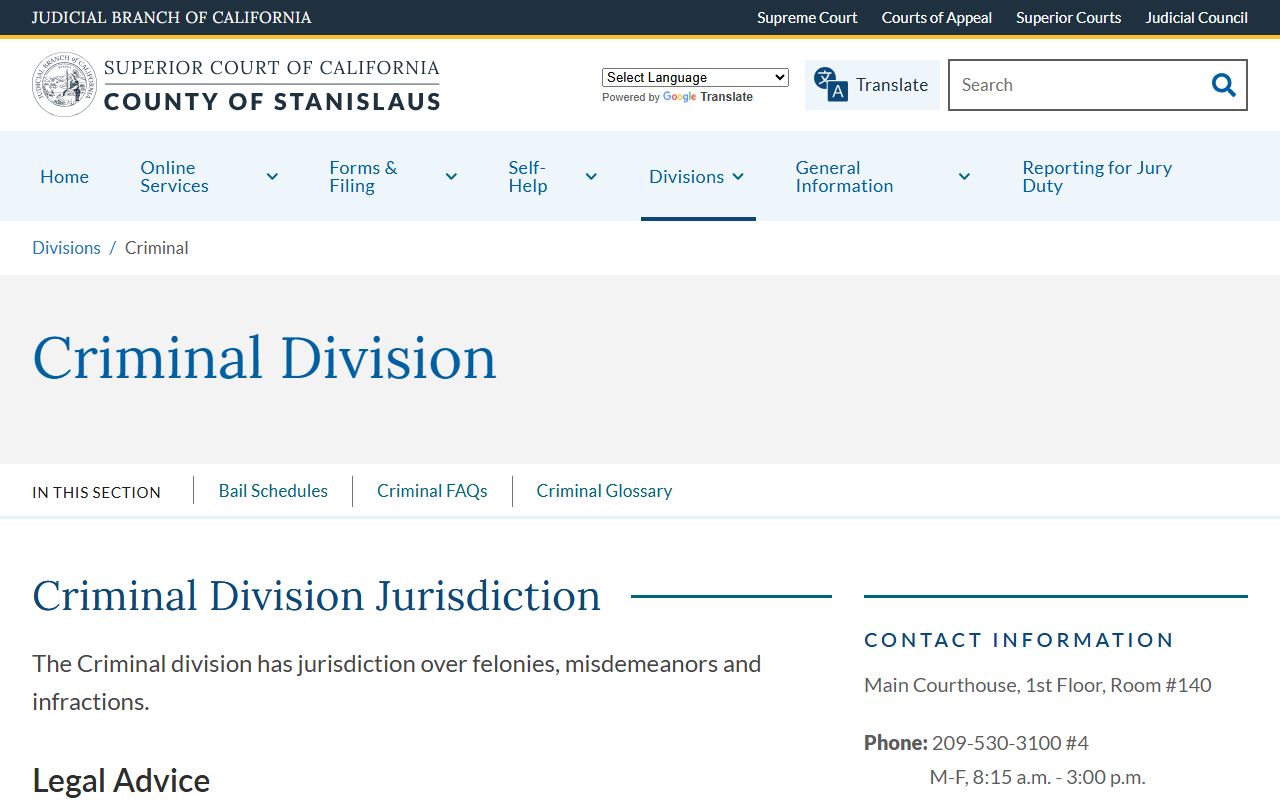
Use the Criminal Division when a court case exists but public online access does not provide enough detail.
Charges Filed After Arrest
The arrest-to-court path has several stages. A local agency arrests and books the person, usually through SDC-East. The Sheriff's roster may then list booking charges, bail, court date, and case number. The DA reviews reports and decides whether to file charges. Once filed, the case lives in Superior Court records, where counts may be amended, reduced, dismissed, resolved by plea, or tried.
| Document | Who Uses It | What It Means |
|---|---|---|
| Complaint | Prosecutor | Common charging document used to start many criminal cases. |
| Information | Prosecutor after preliminary hearing | Felony charging document used after the case moves past early review. |
| Indictment | Grand jury | Grand-jury charging document, less common but possible in serious cases. |
The Stanislaus County District Attorney is the prosecuting agency, not the court case-index custodian.
The DA role explains why a jail arrest can appear in custody records before the formal court charge list is final.
Stanislaus Charge Status Records
Charge status is where court records after a jail arrest differ most from the roster. The roster can show the charge entered at booking. The court file can show the charge the prosecutor filed, later amendments, reduced counts, dismissed counts, plea entries, and final disposition. A reader should compare the booking date and roster charge rows against the court record instead of assuming every booking charge became a conviction.
| Status | What It Means |
|---|---|
| Pending | The case or count has not reached final disposition. |
| Amended | The charge was changed through prosecutor or court action. |
| Reduced | The charge was lowered to a lesser offense. |
| Dismissed | The count or case ended without conviction on that charge. |
| Disposition | The case outcome, such as plea, verdict, dismissal, or other final action. |
| Conviction | A finding or admission of guilt, distinct from arrest or booking. |
Bail After Stanislaus Arrest
The Stanislaus County felony and misdemeanor bail schedules are based on Penal Code 1269b. The research notes that a booking officer, arraignment court, or warrant may set bail under the schedule unless a magistrate orders a different amount or own-recognizance release. Jailer, booking officers, and court clerks may accept scheduled bail for eligible charges. Holds, warrants, parole or PRCS status, and no-bail rules can prevent release even when a dollar amount appears in a roster charge row.
| Release Term | How It Works |
|---|---|
| Cash bail | Full cash payment of the bail amount when release is allowed. |
| Surety bond | Bond posted through a certified surety insurer. |
| Property bond | Court-approved property used after the required court process. |
| Own recognizance | Release based on a promise to appear, without money bail. |
| No bail | Release on bail is not authorized by schedule or court order. |
Note: Confirm release eligibility with the jail or court before relying on a roster bail amount.
Warrants in Court Records
No official Stanislaus County public active-warrant search was located in the research. Warrant information may still surface through related systems. Sheriff's Records Division responsibilities include warrants and due diligence processing. The jail roster may show charges, case number, bail, court date, or holds. Government Code 7923.610 requires public arrest information to include charges the person is held on, including outstanding warrants from other jurisdictions, parole holds, and probation holds, unless a safety or investigation limit applies.
An arrest warrant authorizes arrest. A bench warrant is issued by a court, often after failure to appear. A search warrant is different because it authorizes a search. A fugitive or extradition warrant can involve another jurisdiction. A probation, parole, PRCS, or agency hold can prevent release even when it is not described by the public as a warrant. Practical routes include the court portal, the issuing court, Sheriff's Records, counsel, or a coordinated court appearance.
Charges, Convictions, Sealing
Court records after arrest should be read by stage. An arrest is not a conviction, and a charge can change before final disposition. California law also gives some people a way to seek sealing of eligible arrest records that did not result in conviction. Expungement is a different post-conviction relief concept, and the court record may still have limits or exceptions.
| Topic | First Item | Second Item |
|---|---|---|
| Charge vs Conviction | A charge is an accusation filed or listed in court. | A conviction follows a guilty plea, verdict, or other qualifying outcome. |
| Booking vs Court Record | Booking data comes from jail intake. | Court records show filed charges, hearings, warrants, and dispositions. |
| Sealed vs Expunged | Sealing can hide eligible arrest records from public access. | Expungement is post-conviction relief and does not mean all records vanish. |
Restricted Arrest Court Records
California public access law begins with the California Public Records Act and includes Government Code 7923.610 for specified arrest information. The same research notes that nonexempt public records are open to inspection during office hours, with reasonably segregable portions available after exempt material is removed. Public access does not mean every field is open online. Juvenile records, victim data, medical or mental-health information, protected identifiers, active investigations, and sealed records may be withheld or redacted.
Penal Code 851.91 allows eligible people to petition to seal an arrest record. That matters when charges are dismissed, not filed, or otherwise do not result in conviction and the person meets the statute's requirements. Court staff cannot give legal advice, so sealing questions often require reviewing the forms, court rules, and case history or speaking with counsel.
Important: Public case lookups are not FCRA consumer reports and should not be used for employment, housing, credit, or insurance decisions.